Convenience Food
Convenience Food and the Pattern of the Working Week
Tobias Marsden
·
·
10 min read

There is a particular kind of meal that most people in this city know well: the one eaten standing at the kitchen counter before the commute, or hunched over a laptop between calls. It takes approximately eight minutes. It leaves no particular impression on appetite. And by three in the afternoon, it is as if it never happened.
I kept a log for seven consecutive days in January. Each meal was timed from the first bite to the last, and I noted the setting: table, desk, sofa, standing, walking. I also noted what had been eaten, how hungry I felt at the start, and whether I felt satisfied within the hour following. The results were not surprising, but they were clarifying.
On Monday, breakfast lasted six minutes. I ate a bowl of oats at the kitchen counter while scrolling through messages on my phone. I noted, at the time, that the meal felt adequate. By ten thirty, however, I was reaching for a biscuit from a colleague's desk, which I ate in approximately thirty seconds without sitting down. That biscuit did not appear in my original eating plan for the day. It appeared because the earlier meal had not registered as fully as it might have.
Lunch on Monday was twelve minutes. A supermarket sandwich and a small bag of crisps consumed at my desk, during a lull between tasks. My attention was distributed across the food, a browser tab, and a conversation happening nearby. I finished the sandwich mechanically, and noted in my log that I had no particular recollection of tasting the second half.

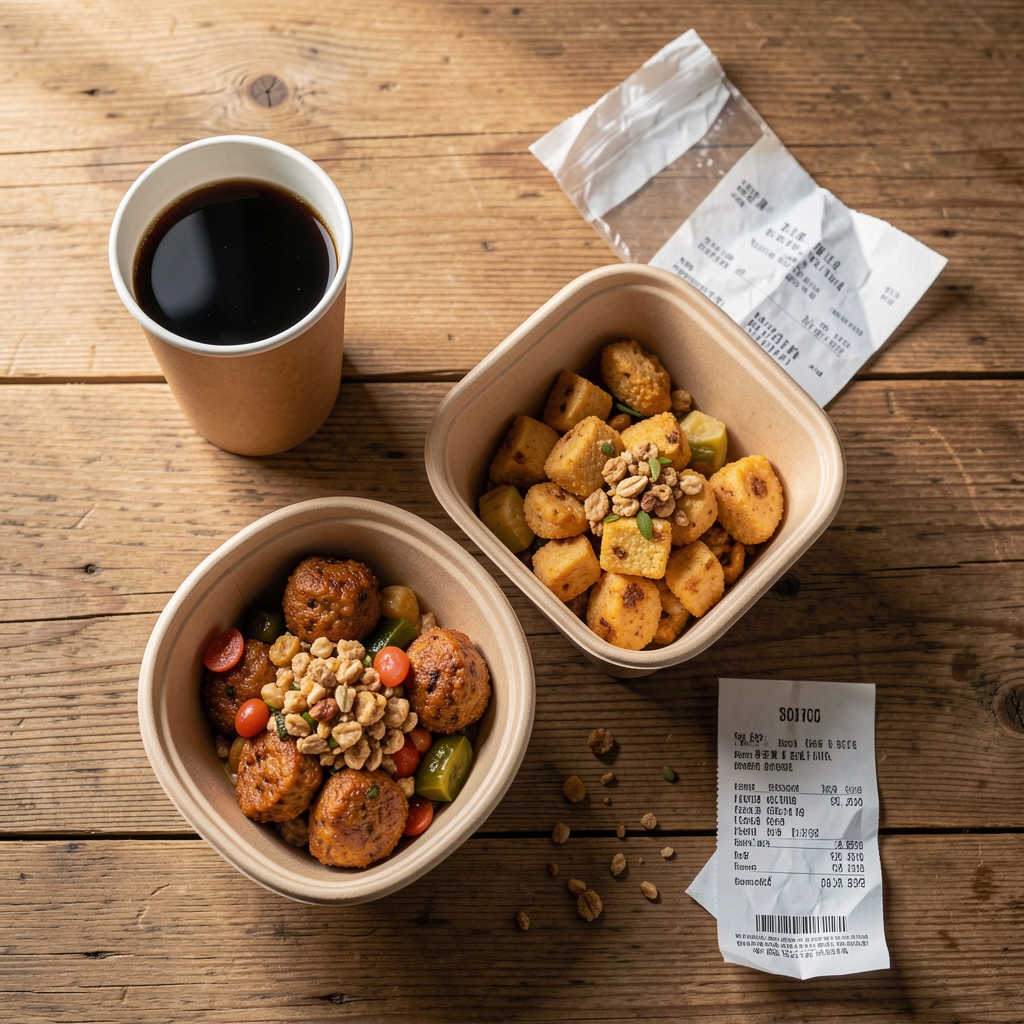
Fig. 1 — Field log, January 2026
The correlation between setting and duration was clear. Every meal eaten at a desk or while standing lasted under fifteen minutes. Every meal eaten at a table without a screen lasted over twenty-five. The setting, it turns out, is not a neutral variable. The conditions in which we eat shape the pace at which we eat, and the pace shapes the experience — and quite possibly the appetite — that follows.
There is a well-documented interval between eating and the body's registration of fullness. In nutritional observation literature, this interval is typically described as somewhere around fifteen to twenty minutes. The implications are straightforward: a meal completed in eight minutes offers no opportunity for the appetite to settle before the plate is clear. What follows — the mid-morning biscuit, the second portion before reflection has occurred — is not weakness of will. It is arithmetic.
"The setting is not a neutral variable. The conditions in which we eat shape the pace at which we eat."
Eleanor Whitfield — Tarnola Journal, January 2026
The log revealed something beyond speed. It revealed the quality of attention during eating. On days when meals overlapped with screen time — a news article read while eating, a podcast playing in the background — the notes recorded afterward were minimal. I could not recall distinct flavours. I noted feeling satisfied in a general sense, but not in a specific one. The meal had been processed, not experienced.
There is a growing body of published research on eating speed and portion awareness. The findings, consistently, point in one direction: a slower meal is associated with greater meal satisfaction and a more accurate sense of how much has been consumed. This is not a novel conclusion. What is perhaps underappreciated is how radically the everyday structure of modern work and convenience food culture militates against the conditions in which slower eating is possible.
The convenience food choices made during this week were not chosen carelessly. They were chosen under time pressure, from a limited range of options, in settings that did not support unhurried eating. The sandwich purchased on Tuesday was not the lunch I would have chosen with forty minutes and a kitchen available. It was the lunch that fitted within the gap between commitments.
The relationship between convenience food and eating pace is not one of cause and effect in a single direction. Convenience food is often engineered for rapid consumption — packaging designed to be held in one hand, formats that require no cutlery, portion sizes that can be finished before a traffic light changes. But the selection of convenience food also follows from the conditions of the day: the shortened lunch hour, the back-to-back schedule, the absence of a kitchen or a meaningful break.
The food choice under time pressure reinforces the pace, and the pace reinforces the choice. These two things do not resolve in isolation. They are part of the broader structure of modern eating habits in which convenience has become the default, and the default shapes the rhythm.
It would be easy, at this point, to conclude with a series of instructions. Eat slowly. Put down your phone. Set a timer. These are not wrong suggestions. But they also reduce a structural pattern to an individual act of will, which is not how patterns actually change.
The more interesting question is not what an individual should do differently at a single meal. It is what the accumulated record of rushed eating habits across a week, a month, a working life reveals about how the contemporary meal environment has been arranged. The desk lunch is not an accident. The availability of food that can be eaten in four minutes is not an accident. These are structures, and they have consequences for the eating rhythm that are worth observing carefully.
The log, at the end of the week, was a small document. Twenty-one entries, each recording a duration, a setting, a level of attention, and a note on appetite. It is not a study. It is a notebook. But notebooks are where observation begins, and it is observation — careful, particular, and consistent — that forms the basis of everything this publication tries to do.
Key Observations

Written by
Eleanor Whitfield
Eleanor Whitfield is the founding editor of Tarnola Journal. She writes on food pace, everyday eating habits, and the relationship between meal environment and portion awareness. Her work draws on published nutritional observation research and first-person field notes.
More from this author →